Krista Tromp is an ethicist who works both as an ethics policy advisor at the Royal Dutch Medical Association (KNMG) and as a medical ethicist at Erasmus MC.
Krista Tromp is an ethicist who works both as an ethics policy advisor at the Royal Dutch Medical Association (KNMG) and as a medical ethicist at Erasmus MC. This dual role allows her to be involved in pediatric palliative care at various levels. For Krista, this combination of working in a policy organization and in practice is essential. She is driven to strengthen healthcare professionals, connect disciplines, and contribute to the education of medical students and physicians. A busy bee with an ideal in mind!
"I want to improve practice and actually achieve change. My field is reflective, but I always want to move forward with action!" Her tools are words and listening. She asks the questions that need to be asked, she listens to understand others, and analyzes dilemmas to arrive at convincing arguments. Her focus is on the dynamics within the triangle of parents, child, and healthcare professionals. For Krista, a great day is when she succeeds in getting people to truly engage in conversation and they tell her: "I thought about it a bit longer, Krista. It really helped me."
'Unraveling' a dilemma
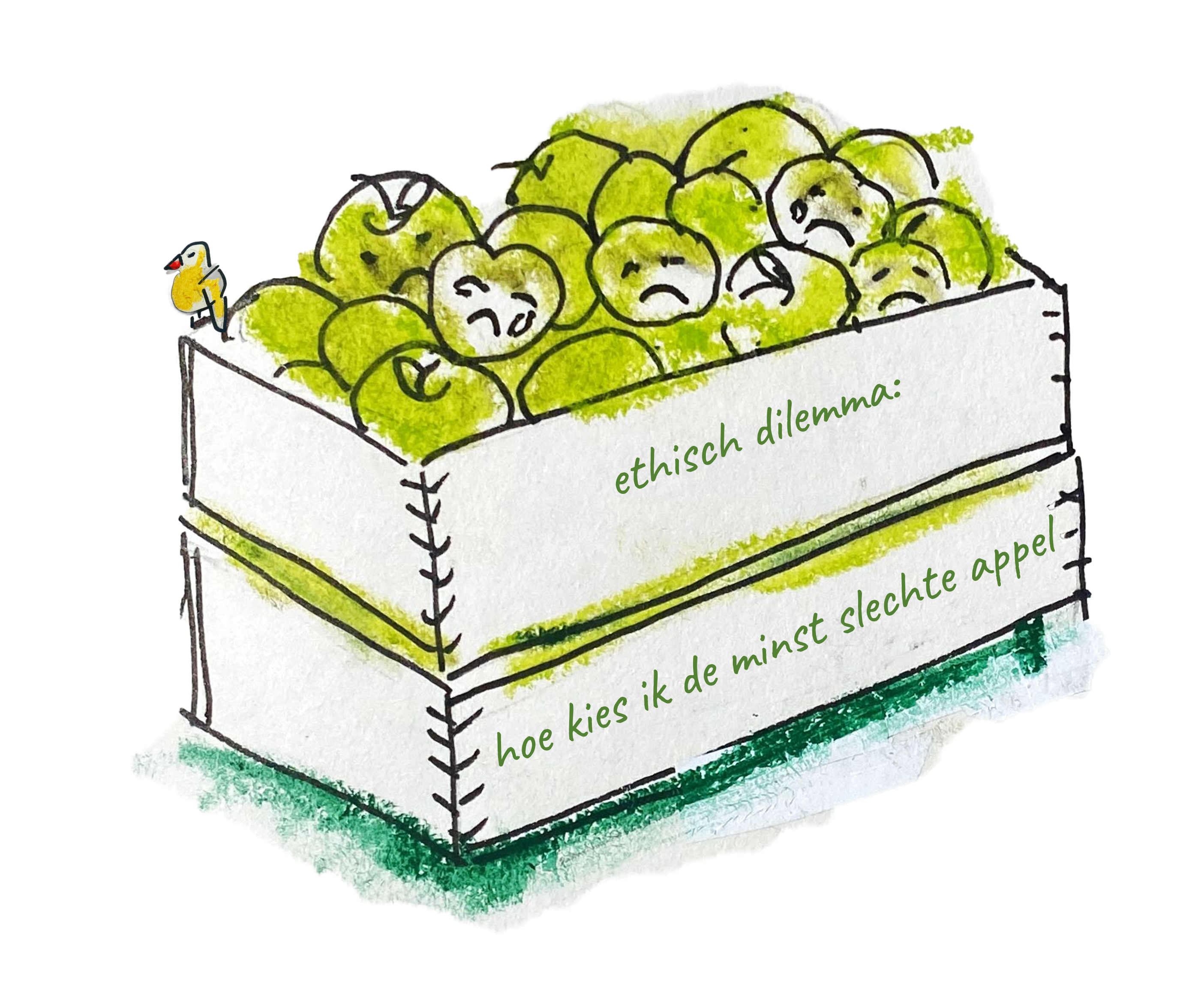
What are ethics, anyway? The ethical perspective of a dilemma involves choosing between several options, all of which have negative consequences. None of the options are ideal, but you must choose the least harmful choice to minimize the impact and avoid unhappiness. So, "unraveling" the dilemma means thoroughly examining the dilemma and discussing it extensively with those involved. By considering all aspects of the dilemma and trying to put them into words, you can ultimately arrive at a well-considered and well-reasoned decision. I always say that ethics focuses on choosing the least bad apple in the crate. This process of in-depth analysis and discussion, for me, is the core of the ethical perspective on a dilemma. You have the freedom to make a decision, but you also have the responsibility to justify it.
Dialogue tables
At the initiative of the Children's Palliative Care Knowledge Center, I was involved in setting up dialogue roundtables. Parents of children with severe intellectual and multiple disabilities (ZEVMB) felt the need to engage in conversation with healthcare professionals and learn from each other. Instead of an extensive process involving developing guidelines or conducting a survey, we opted for immediate results. Parents and healthcare professionals engage in dialogue and make "the undiscussable, discussable." Together with a facilitator, they sit in a room for an entire day, without an agenda or program. New insights are immediately incorporated. We anticipated the conversation would be quite challenging. Healthcare professionals already find it difficult to discuss complex ethical issues, so can we really ask parents to do so? How difficult is it for them to openly and honestly engage in this conversation with their treating physician, on whom they depend for their child's care, often uncertain, anxious, and "medically ignorant"! The desire to talk, learn, and share experiences proved to be strong. Having conversations that focus on the essentials, without working towards a result, truly engaging in dialogue with each other. "I give my child's quality of life a 7, but our family's quality of life is perhaps only a 4." Are we allowed to say this? Yes, we can! During the dialogue roundtables, we must find the courage to talk to each other and to dare to disagree. If everyone agrees, we haven't thought long enough. Ethics plays a crucial role in pediatric palliative care. While we cannot improve the situation ourselves, ethics can help us make complex choices more bearable. The Knowledge Center is currently exploring how we can further develop the input from these dialogue roundtables into concrete tools for practice, but also how initiatives like this can be used in the future to enrich our knowledge.
Innovative initiatives
At Erasmus MC, I'm closely involved in setting up a new initiative: the Erasmus Expertise Center for Ethics. This Center also addresses complex issues related to palliative care and euthanasia. Its responsibilities include training ethics ambassadors in various departments and organizing ethical consultations for difficult ethical dilemmas.
Ethics ambassadors are healthcare professionals who continually ask themselves what constitutes good and appropriate care, from an ethical perspective, in a complex situation. Erasmus MC currently has 55 ethics ambassadors, including nurses, facility care staff, outpatient assistants, medical specialists, and professors. This broad approach is characteristic of the course we follow at Erasmus MC. The medical specialist has a different perspective than the nurse, who sees the patient all day long. Everyone contributes their own piece of the puzzle.
In the moral deliberation, which we intensify within our hospital, we also bring together all the involved parties. We determine who should be represented on a case-by-case basis, and this isn't limited to the hospital itself. Parents, general practitioners, or social workers can also be involved. Together, you learn to see your own blind spots. In a moral deliberation, you discuss difficult choices you have to make in existing situations. The initiative for a moral deliberation lies with the staff, with us acting as facilitators and discussion leaders. You openly share your thoughts according to a predetermined method. This involves critically examining your own assumptions and beliefs. We call it a moral deliberation, but it's actually about "asking, listening, sharing, and sharing," sifting through the chaos surrounding a complex dilemma, and finding a common language. The first step is identifying the differences and expressing the discomfort, then looking for an argument for the "ethical discomfort." Only then do you truly have something to discuss. So, first, there's the disagreement, and then, based on reasoning, a consensus is reached. An ethical deliberation also shows parents that medicine isn't an exact science. Healthcare professionals also have their doubts about complex dilemmas and aren't sure what the ideal treatment is in such a complex situation. It's good for parents to recognize this doubt and uncertainty, because healthcare professionals are often a 'black box' for them. A decision resulting from an ethical deliberation is often more acceptable. The decision may not be perfect, but at least it's based on reasoning.
Children are the experts about themselves
I have a PhD in pediatric drug research. I've seen that children, too, can make very clear choices. An example of a seriously ill 15-year-old boy has always stuck in my mind and often comes to mind when we talk about children instead of with them. He participated in a phase 1-2 study and very deliberately said: "This way, I'm contributing to the world and I can help other children." I spoke with his mother only briefly. "If he says it like this, then it's true." That resonated with me and strengthened my belief: children can make decisions! With the right tools, children from a young age, even under 12, can participate in discussions about difficult topics and express themselves clearly on what's needed. Healthcare professionals have their own expertise; children are the experts on themselves.
Illustrations by Maartje Santema