All about the development of paediatric palliative care in Spain.
Authors: Jose Antonio Salinas, Sergi Navarro, Ricardo Martino, Fatima Parra, Macarena Rus, María José Pelaez
Can you tell us a little about yourself, your role and your participation in PPC in your country?
Jose Antonio Salinas chairs the Paediatric Onco-Haematology Unit of the Son Espases University Hospital in Palma de Mallorca and is the coordinator of the Pediatric Palliative Care Group of the Spanish Society of Pediatric Hemato-Oncology (SEHOP). He organized several pediatric palliative care (PPC) courses in Spain that served as the basis for the creation of the Spanish Society of Pediatric Palliative Care (PEDPAL).
Ricardo Martino has been dedicated to and advocating for PPC on several fronts in Spain. He started volunteering as paediatrician at “Casa de Belén” in 1995, a home for orphan children suffering from AIDS created to provide them a home death. He is Head of the PPC Unit of the Community of Madrid; implemented an MSc course in PPC for the advanced training of doctors and nurses; created the Porqueviven (Because they are alive) Foundation; co-founded PEDPAL; is an advisor to the Ministry of Health and Regional Councils.
Sergi Navarro is the Head of the Palliative Care Section and Complex Chronic Patient at the San Joan de Déu (SJD) Hospital in Barcelona, and of the Pediatric Intermediate Care Center “La Casa de Sofía”. He is also coordinator of the Comprehensive PPC Network of Catalonia, co-founder and current President of PEDPAL.
Maria José Peláez is a paediatrician at the Unit of Complex Chronic and Palliative Care of the Regional University Hospital of Malaga since 2012. She was a co-founder and is the current Vice President of PEDPAL.
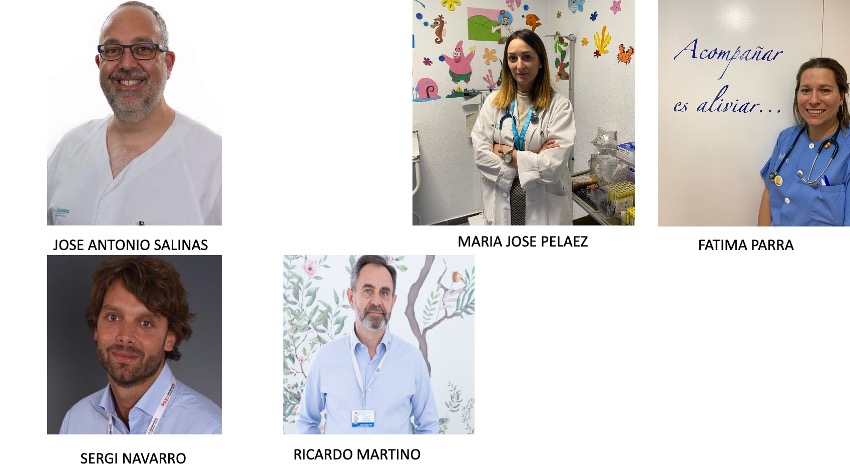
Fátima Parra is a paediatrician, with the subspecialty of PPC, working at the PPC Unit of Aragon and a member of the Board of PEDPAL. She teaches at the MSc PPC course and developed the clinical practice guideline for PPC of the Spanish National Health System.
Macarena Rus Palacios is a paediatrician, with the subspecialty of PPC, working at the PPC Unit of the Virgen del Rocío University Hospital in Seville, which she founded in 2016. She also founded and is the current President of the SISU Association (Andalusian Association of PPC) for the promotion and development of PPC in the region of Andalusia.
Can you tell us about the beginnings of the establishment of PPC in your country?
In 1991, the first PPC unit was set up at the SJD Barcelona Children's Hospital. In 1997 one was created in the Maternal and Child Hospital of Las Palmas; in 2008 in the Hospital Niño Jesús in Madrid and in 2013 another in Son Espasses (Mallorca). Since then the Units have developed more or less uniformly in the rest of Spain.
- Who was the driver? Who led it?
The idea for PEDPAL arose in 2013 after repeated meetings of the various professionals acting in PPC training activities – Jose Antonio, Sergi, Ricardo and Eduardo Quiroga. After recognizing the scarcity and inequity of resources, the idea of forming a common front to bring together everyone involved in PPC began to take shape, with the aim to support the development of PPC in Spain.
In 2014, this group, comissioned by the Ministry of Health, published the National Strategy for PPC, which was approved by the Interterritorial Council urging the ministries of the different Autonomous Communities of Spain to develop PPC.
The movement gained strength and finally on March 3, 2016 during the 1st PPC Day Meeting of the region of Murcia the statutes and the founding act for PEDPAL were signed. Sergio (president), María José and Ricardo were members of the first Board, together with Ángela Tavera Tolmo, Moisés Leyva Carmona, Álvaro Navarro Mingorance, Laura Rubio Ortega, and Lucía Ortiz San Román.
- What was the model, e.g. hospital/community/hospice/combined model?
The initial services were undertaken by professionals working in hospitals, with some action towards homecare. The scope depends a lot on the available resources, as well as the dedication and will of the local professionals. The first "regional" model, which tries to give a global response, was the one in Madrid led by Ricardo.
The Spanish health system is mostly public. As such, the financing of PPC services is usually public, included in hospital services and homecare units. From there it has been expanded to outpatient care and 24/7 care, but with an irregular provision. The collaboration of the third sector has been incorporated to complement this, and now paediatric hospices are also being started.
- Which of these first steps made a real difference?
There were two moments that we believe made the difference, both happening in 2014
The publication of a document with criteria for referral to PPC, establishing the framework for the organization of services and the provision of PPC in Spain.
The start of advanced education, with the MSc in PPC. To date, 300 doctors and nurses from Spain and Latin America have been trained, and most doctors and nurses currently working in PPC in Spain have advanced training.
Also, the creation of PEDPAL has been allowing PPC to be present in pediatrics’ activities throughout Spain. In addition to PEDPAL's Congresses, PPC is now a topic in Congresses and books of different specialties (intensive care, neonatology, oncology, neurology, pulmonology, primary care, hospitalization, emergencies, adolescents ...).
Have things moved now? What kind of PPC model(s) exist now?
Currently in Spain the disparity of existing resources is still very important and there is no standardized classification in PPC. However, we have tried to group the different possible models of care:
1. GROUP 1
-
- Complete health team (doctor + nurse)
- Complete psychosocial care team (social work + psychology)
- 24/7 shiftt
- Own beds
2. GROUP 2
-
- Complete health team (doctor + nurse)
- Partial psychosocial care team (social work and/or psychology)
- 24/7 or end of life care shifts
- +/- own beds
3. GROUP 3
-
- Complete health team (doctor + nurse)
- Partial psychosocial care team (social work and/or psychology)
- No shifts
- +/- own beds
4. GROUP 4
-
- Partial health team (doctor and/or nurse)
- Partial psychosocial care team (social work and/or psychology)
- +/- shifts
- +/- own beds
5. GROUP 5
-
- Partial health team (doctor and/or nurse)
- No psychosocial Care Team
Is the PPC anchored in laws, regulations and/or government policies in your country? If yes, do you know when these CFP policies were introduced in your country?
In December 2005, the "NHS Palliative Care Strategy" began with review, evaluation and finally approval in March 2007. Taking into account the new evidence, the objectives of the 2007-2014 strategy were agreed upon.
In April 2013, the II National Strategic Plan for Children and Adolescents 2013-2016 was approved. Among the objectives are to "promote actions to achieve the maximum development of the right to public health of children and adolescents, from health promotion to rehabilitation, giving priority to the most vulnerable populations", as well as "to provide the child and adolescent population in an advanced terminal phase and their families, an assessment and comprehensive care adapted at all times to their situation, at any level of care and throughout this process". Finally, in 2014 the document "PPC in the National Health System - Care criteria", was published, which describes the peculiarities of PPC, the current situation in Spain, the epidemiology and criteria for referral in children.
If yes, do you know which domains are covered by this policy?
- Homecare / Community Care / Outpatient Care
- Hospital / Inpatient Care
- Identification of resources and initiatives in Pediatric Palliative Care in Spain
- Dedicated hospice services
In 2021 launch of Casa Sofia, in Barcelona. There is currently a Project in Madrid of the Porqueviven Foundation and another in Málaga of the Cudeca Foundation.
Can you prioritize from the list below what are currently the biggest barriers to further PPC development?
- Lack of political prioritization
- Lack of funding for services
- Workforce issues
- Public awareness (taboo, misunderstandings about palliative care for children)
- Lack of training opportunities
Any other common barriers to providing PPC include:
- Lack of cohesion between the autonomous communities (there are 17 in Spain, plus two autonomous cities). Every part of the country has its own way to provide specialized PC. There are few places where international recommendations are followed.
- Lack of palliative care teams. In Spain, only 15% of the 25,000 children estimated to need palliative care receive it. Barriers related to organizational scale, 'absence of formal ratification of intervention by management' and 'unstable organization'.
- Lack of multidisciplinary teams providing ongoing support throughout the patient's disease trajectory, including 24-hour availability for care consultation.
- Specialists do not identify the timing of referral to PPC. Prognostic uncertainty and time constraints and, therefore, discomfort with the provision of PC.
- Lack of knowledge, experience, education, or support from staff who need to make a referral to a PPC team.
Are there other barriers to developing PPC? Any that are specific to your country?
Fragmentation of service providers in the Public Health System. The need to multiply the work to convince politicians.
Although the situation has improved, there are still very few units. What resources are currently available and why are they insufficient?
There are currently around 30 PPC teams in Spain, but the service provision varies a lot. For example, in Madrid and Barcelona we can provide homecare and 24 hours a day, but there are many other places that have none of that, not even a multidisciplinary team. The resources are insufficient, and that is a recognized right, but since these children are few and do not vote, nobody gives them priority. In Spain, three thousand children die a year and it is estimated that about 25,000 currently need palliative care in Spain. Little by little it is improving, especially since 2014, when the Ministry of Health published a document with criteria for attention and recommendations, but, as each autonomous community is sovereign in the provision of services, there is a lot of inequality between them.
There are communities that do not have units or even recognized equipment. The autonomous communities are very diverse, in terms of extension and population. And you have to adapt the service to the peculiarities of each one, but there are communities in which nothing has been invested in 10 years, and that cannot be, because in 2014 all the counsellors committed to do so, but at the moment of truth, many have not done so.
There are by no means the same resources as for adults.
On reflection, is there anything you think could have been done differently or better?
Yes, if there had been greater involvement of the Ministry of Health in the regional implementation of national guidelines.
Also, there is no national law that mandates the provision of PPC.
Any lessons to share with other countries?
The creation of PEDPAL and the development of uniformed education and training.
Is there anything you are really proud of in terms of the development of PPC in your country?
Yes.
- The increase in the number of teams in the last 10 years
- The uniformity of education and training for doctors and nurses
- The creation of the scientific society PEDPAL
- The role of the Porqueviven Foundation
- The incorporation of perinatal palliative care since the 2014 document
What do you think an international network could do to support the development of PPC?
- Establish minimum standards of care and identify best practices in PPC.
- Identification of the different models of care in PPC that can be applied in different geographical, cultural and social areas.
- Disseminate strategies for the implementation and development of PPC that can serve as a model in other geographical and social areas.
- Encourage research.
- Promote the involvement of professionals from all the areas of care of patients in PPC, as well as families. Create area specific working groups.
- Define quality of care indicators that allow teams to obtain quality certification.
- Create spaces to share clinical knowledge and management experience in PPC.